E-liquid mixing chart for shortfills
You have a base, a nicotine shot and a bottle of concentrate, and the numbers blur the moment you start pouring. Too much of one thing and the mix turns harsh, too little of another and it tastes of nothing. An e-liquid mixing chart turns that puzzle into three lines of arithmetic, provided you know what each column represents and in which order to read them.
How to read an e-liquid mixing chart
Any chart of this kind crosses two settings: the nicotine strength you are aiming for and the share of concentrate, both always expressed against the final volume rather than against the base.
Fix the final volume in millilitres first, then the strength in milligrams per millilitre, then the concentrate percentage. The chart returns three quantities: the millilitres of nicotine shot, the millilitres of concentrate, and the neutral base that fills the rest. Those three always add up to the final volume.
The PG/VG ratio is a separate question, and it comes almost entirely from the base you buy. A 50/50 base suits pods and tight draw tanks, while a 30/70 base is aimed at hardware built to produce vapour.
British formats shape the whole exercise. Nicotine is sold here only in bottles of 10 ml or less at up to 20 mg/ml, which is why shots come in 10 ml units and why every calculation below is built around that size.
The shortfill and nicotine shot chart
The simplest form of mixing needs no base at all. A shortfill is a flavoured, nicotine free liquid deliberately underfilled so a shot fits in the headroom, which is why the bottle is always larger than the liquid it contains.
| Shortfill | Bottle size | Shots added | Final volume | Resulting strength |
|---|---|---|---|---|
| 50 ml | 60 ml | 1 x 10 ml at 18 mg/ml | 60 ml | 3 mg/ml |
| 50 ml | 60 ml | 1 x 10 ml at 20 mg/ml | 60 ml | around 3.3 mg/ml |
| 100 ml | 120 ml | 2 x 10 ml at 18 mg/ml | 120 ml | 3 mg/ml |
| 100 ml | 120 ml | 2 x 10 ml at 20 mg/ml | 120 ml | around 3.3 mg/ml |
Two things follow from that table. The shot strength on the label changes the result even when the volumes are identical, so it is worth reading rather than assumed. And the shot brings its own PG/VG ratio with it, which shifts the finished bottle slightly away from the shortfill’s stated ratio.
The full DIY e-liquid mixing chart
Mixing from scratch replaces the flavoured shortfill with neutral base plus concentrate, which is what gives you control over the flavour intensity. The figures below assume 12 per cent concentrate and 18 mg/ml shots.
| Final volume | Neutral base | Shot at 18 mg/ml | Concentrate at 12% | Resulting strength |
|---|---|---|---|---|
| 30 ml | 21.4 ml | 5 ml | 3.6 ml | 3 mg/ml |
| 60 ml | 42.8 ml | 10 ml | 7.2 ml | 3 mg/ml |
| 100 ml | 71.3 ml | 16.7 ml | 12 ml | 3 mg/ml |
| 120 ml | 85.6 ml | 20 ml | 14.4 ml | 3 mg/ml |
To aim at a different strength, only the shot column changes and the base absorbs the difference. To change the finished ratio, swap the neutral base for another one without touching the other quantities, and the result slides towards more vapour or more throat sensation accordingly.
The formula, so you never need the chart again
Two operations cover everything. The shot volume is the final volume multiplied by the strength you want, divided by the strength of the shot. The concentrate is the final volume multiplied by the recommended percentage. The base fills whatever is left.
A 60 ml bottle at 3 mg/ml with an 18 mg/ml shot needs 60 times 3 divided by 18, which is 10 ml. A 120 ml bottle at the same strength needs 120 times 3 divided by 18, which is 20 ml, or two shots.
That formula is also the honest answer to the strength question, because the right target is personal and no chart can decide it for you. What the arithmetic guarantees is that whatever you settle on is reproducible, and that you never exceed the 20 mg/ml ceiling that applies in the United Kingdom.
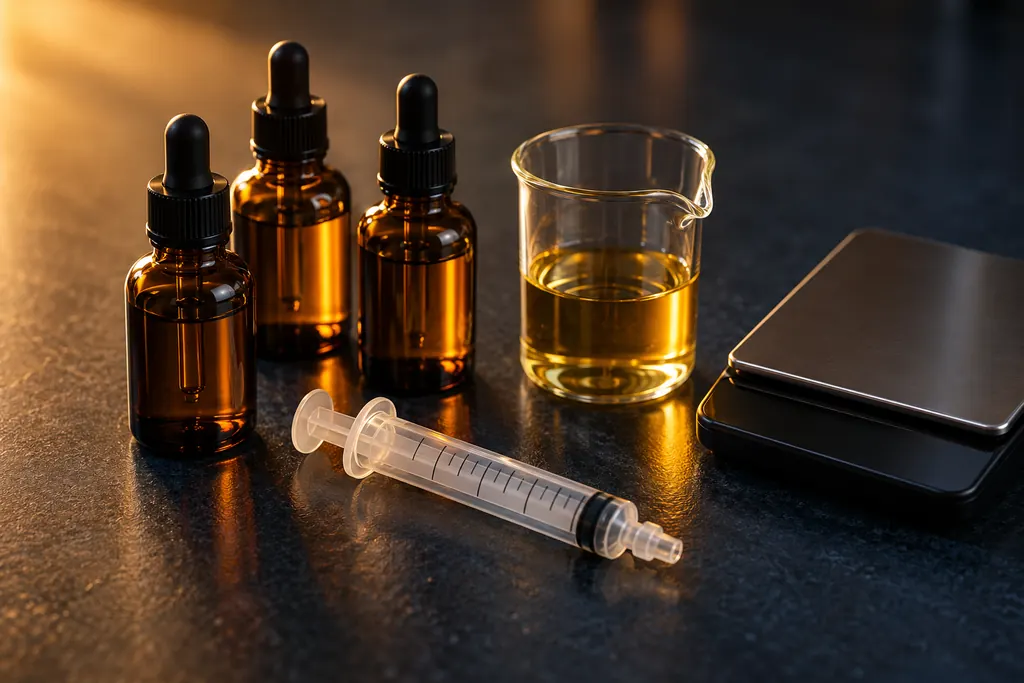
For converting a volume into drops, count roughly 25 drops per millilitre. Treat that as an order of magnitude, since it depends entirely on the dropper. The whole bench and the order of operations are covered in our guide on how to make your own e-liquid.
Mixing by weight, the more precise method
Few pages explain this, yet weighing usually beats measuring. On a set of small scales every ingredient has a density: vegetable glycerine sits around 1.26 g/ml, propylene glycol around 1.04 g/ml, and most concentrates close to 1 g/ml.
Working in grams rather than syringe marks removes the two things that ruin repeatability, the air bubble you did not notice and the residue clinging to the barrel. It is also faster once you are used to it, because nothing needs rinsing between components.
The method is straightforward. Tare the bottle, add each component in turn while watching for the target weight, which is the volume you want multiplied by that component’s density. Around 43 ml of a 50/50 base weighs roughly 49 g, and precision to a tenth of a gram makes any recipe reproducible attempt after attempt.
Safety habits belong in the same routine. Wear nitrile gloves when handling nicotine shots, wipe spills immediately, and store bases, shots and finished bottles away from light and well out of reach of children and pets.
Adjusting the ratio to your hardware
The PG/VG ratio decides throat sensation and vapour volume, and it is the setting most often left to chance. More propylene glycol gives a sharper sensation and suits a tight draw on a high resistance coil.
More vegetable glycerine thickens the vapour and softens the draw, at the cost of gumming the wick up faster and needing the larger wicking ports of a sub ohm build to keep up with demand.
Match that choice to your vape coil rather than to the recipe, since a mismatch between a thick base and a small pod is the usual cause of dry hits and seepage. The flavour family matters too, and our guide on how to choose an e-liquid flavour lists the steeping times each one needs.
Frequently asked questions
How do I calculate a DIY dose?
Fix the final volume, then work out the shot as volume times target strength divided by shot strength, and the concentrate as volume times the recommended percentage. The base fills the rest.
How many nicotine shots does a shortfill need?
A 50 ml shortfill in a 60 ml bottle takes one 10 ml shot, and a 100 ml shortfill in a 120 ml bottle takes two. The headroom in the bottle is sized for exactly that.
How do I choose a PG/VG ratio?
A 50/50 base suits pods and tight draw tanks, while 30/70 is aimed at hardware built for vapour. The ratio follows the coil and the draw rather than the flavour.
How much concentrate goes into a neutral base?
Follow the percentage the maker prints on the bottle, commonly between 8 and 15 per cent. For 30 ml at 12 per cent, that is 3.6 ml, or roughly 90 drops.
How do I mix without any nicotine?
Leave the shot out entirely and let the neutral base take its place. For 60 ml at 12 per cent concentrate that gives 7.2 ml of concentrate and 52.8 ml of base.
Keeping the chart useful
Three columns, one formula and a set of scales cover every mix you are likely to make. The chart saves time on the bottles you make often, and the formula rescues you on the ones you do not.
Write down what you did on the label, every time, because a mix that works is only useful if you can make it again. Note the date, the final volume, the concentrate percentage and the shot strength, and the next bottle becomes a two minute job rather than a fresh calculation. Used that way, an e-liquid mixing chart stops being a lookup table and turns into a record of what actually worked on your own hardware.
Editorial content for adult readers only. Vaping products usually contain nicotine, a substance that causes addiction. Not for sale to under-18s in the United Kingdom. This article is not a buying recommendation.